
Permafrost gameplay revolves around prepared expeditions: leave shelter with a concrete goal, scavenge or hunt, return with useful materials, then craft or repair something that lets you travel farther. Cold, weather, equipment, and your return route shape that loop. Progress comes from connecting exploration to new tools, clothing, workbenches, and story objectives rather than simply collecting everything you see.
You control Rook in a third-person, story-driven open world. You can play alone or with up to three friends in a player-hosted world. The game is in Early Access, so implemented systems coexist with known faults and planned additions. This explains the current play loop; it does not promise a finished endgame, fixed performance, or access to roadmap content such as White Hell.
Data version: Numerical recipe or quest entries from MetaBot use its 0.44.2.4634-milestone export. This is a source reference, not confirmation that every entry remains available after later patches.
Make each expedition answer one practical need
The central decision is what the next trip should accomplish. A useful expedition has an outcome you can name before departure: bring back a material, reach a character, inspect a quest landmark, hunt for a required resource, or establish another usable shelter. A vague goal such as exploring until your inventory is full makes it harder to judge when to turn back.
Think of the loop in this order:
- Identify the next item, repair, or objective that changes what you can do.
- Check its prerequisites, including a blueprint, station, tool, or active quest.
- Pick a destination that resolves the missing prerequisite.
- Prepare equipment and a return route for that destination.
- Bring the useful result back and perform the craft, repair, or interaction.
- Reassess which new option the result has opened.
This approach makes exploration purposeful without requiring a rigid path through the whole game. You may discover another interesting place on the journey. Record it and decide whether it serves the current task or belongs to a later trip. The cold and your carried supplies remain relevant even when a new landmark appears.
A successful outing is not defined by the largest haul. A small load that finishes a necessary tool upgrade can change your next journey more than a full inventory of materials that have no immediate use. Judge the trip by the capability it gives you when you return.
Cold changes the value of distance
Cold is an ongoing part of movement and planning. Storms, frostbite, and falling warmth turn preparation and shelter into travel decisions. A destination can be geographically close yet demanding if it exposes you to a colder area or leaves no clear recovery stop on the way back.
Before extending an outing, check whether your current equipment supports the next area and whether the return is still manageable. Do this at a meaningful boundary: leaving shelter, entering a cold zone, finishing the main task, or considering a detour. Waiting until the trip has already become difficult removes useful choices.
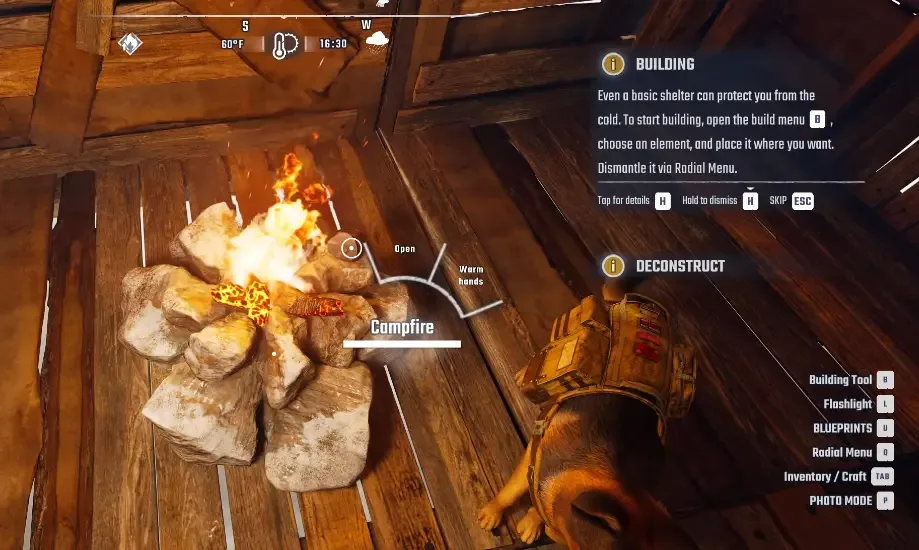
A recovery-stop reference for the warmth and shelter part of an expedition.
Do not treat equipment upgrades as permission for unlimited exposure. Better clothes expand your options, but weather and return preparation still matter. There is no verified universal exposure timer in this guide, so a precise statement such as a fixed number of safe minutes would give false confidence.
Shelter is therefore part of the route rather than merely a place to decorate. A useful shelter network gives journeys recognizable start and return points. When choosing what to build or restore, ask which destination becomes easier to reach afterward. That ties construction to exploration instead of treating the two systems as separate activities.
Scavenging and hunting solve different shortages
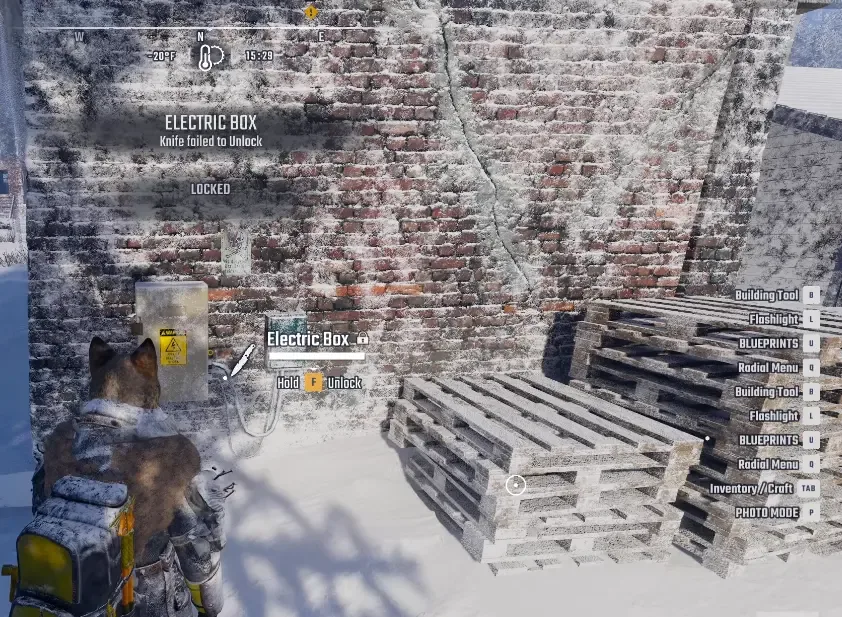
A scavenging interaction reference: check the required action before treating a container as usable loot.
Scavenging takes you through abandoned settlements, ruined buildings, vehicles, and other remnants of the old world. Hunting takes you into wildlife encounters and can support food or material needs. The right activity depends on the missing part of your next craft or objective.
Check the material name before leaving. A raw object, a processed crafting material, and a quest item are not interchangeable. For example, finding a dismantlable item does not automatically create scrap in your inventory. You still need the relevant processing step at a dismantling workbench.
A gathering plan should answer three questions in ordinary terms: what are you looking for, what tool or interaction allows you to obtain it, and what you will do with it afterward. If one of those is unknown, the outing may be a reconnaissance trip rather than a guaranteed material run. That is a useful distinction because it keeps expectations realistic.
Avoid assigning a respawn rule to every resource category. This guide does not establish a universal schedule for trees, containers, animals, or mineral deposits. Seeing a resource on one trip does not prove it will be present again after a particular wait. Keep a record of what you actually find, then choose an alternative task if the expected resource is absent.
Crafting is a chain of access, not just a recipe
An item can require several separate things: a learned blueprint, a specific station, carried materials, and a suitable point in progression. Looking only at its name or icon misses the reason a craft remains unavailable.
Work backward from the item you need. Find the missing layer first, then spend the next outing on that layer. If the recipe is unknown, gathering more ingredients may not help. If the recipe is learned but the station is missing, a station unlock or a visit to an existing bench can be the useful next action.
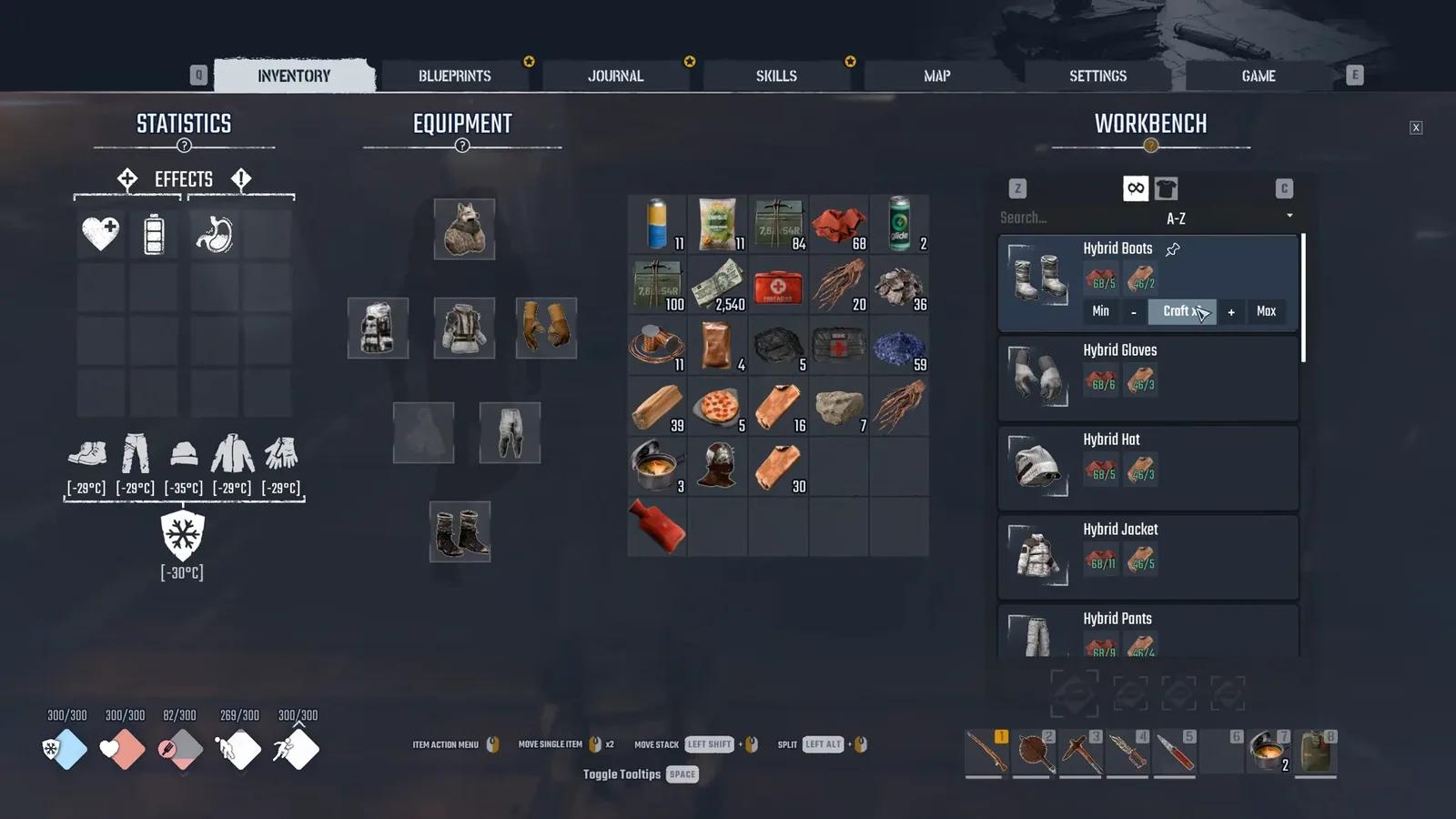
The workbench panel shows how an equipment craft depends on a recipe and materials; check values in your own build.
The tool you produce then changes future resource access. The current Moonstone case illustrates this clearly: an ordinary Iron Pickaxe is not enough, despite an incorrect description. The required tool is a Quality Iron Pickaxe. The important gameplay lesson is to inspect the exact tool tier instead of assuming that any iron version solves the obstacle.
Do the same with clothing progression. A task that sends you into colder surroundings can be directing you through a preparation chain. Finishing the clothing or station step may be more useful than repeatedly trying the destination with the same equipment. Read the current objective and crafting screen together before deciding which material to hunt next.
Repairs and construction should extend the next route
Permafrost lets you build and restore shelter as part of reclaiming a frozen world. The practical value of a structure depends on what it enables: a place to recover, a station to process materials, a storage arrangement, or a base from which the next journey is easier.
Prioritize function when the next expedition is blocked. A crafting station that completes an equipment chain, for example, can have a clearer immediate purpose than additional decorative construction. This is a planning recommendation, not a claim that the game assigns a superior reward to one building style.
Restoration also intersects with quests. A visible broken machine is not always an instruction to repair it immediately. A tower repaired before High Frequency is activated may fail to register for that quest. The current guidance also places the base radio before the tower radio. Explore freely, but check the active objective before consuming a one-time interaction.
That distinction helps you read the world: discovery tells you a place or object exists; progression tells you when using it has the intended effect. The best time to build or repair is the time that supports the task you are currently trying to finish.
The radio story gives exploration a direction
Rook is drawn into the frozen world by a radio signal from a long-lost friend. Story tasks connect conversations, landmarks, repairs, blueprints, and equipment. Following that sequence gives exploration a practical direction while leaving room for separate gathering and hunting trips.
Read a new objective before taking reward items or using nearby quest devices. A blueprint collected before its quest becomes active may not register. This does not mean every optional discovery is harmful; it means certain quest interactions have a state requirement that a map marker cannot show by itself.
The latest verified quest changes allow High Frequency to complete while Hopes and Dreams is active. Do not treat those two active quests as a reason to stop normal progression. However, fixes for newly collected recordings do not guarantee repair of every older save that already suffered the recording-registration bug.
Use the journal to distinguish three situations: you have not reached the destination, you reached it but still need the required item or action, or the action was performed but the objective did not update. Those lead to different next moves. More exploration can resolve the first two; repeating unrelated tasks is unlikely to clarify the third.
Co-op changes responsibility as well as manpower
A multiplayer world supports up to four players total, including the host. The host owns the world state and must be online for guests to play there. Characters are tied to the world, so joining a friend does not import your separate solo character.
Divide useful work by the shared goal. One player can gather while another prepares a station or organizes supplies, but agree on which craft or repair the materials serve. Four people collecting unrelated items can still leave the same progression requirement unresolved.
For main story steps and Skinwalker quests, current guidance puts the interaction responsibility on the host. Guests can reach the right location and help with ordinary survival tasks, yet a guest performing the key story interaction may not advance the objective correctly. Assign that role before opening a reward box or completing a repair.
The world has one dog, belonging to the host. Its intended functions include scouting, danger warnings, and carrying supplies. Guests may see a moving harness without the dog because of a known visibility issue. Do not treat that image as proof that the world contains no companion or that each guest should obtain a separate dog.
Recognize the difference between a gate and a bug
Some obstacles are progression gates: a missing tool, an unlearned recipe, a station requirement, or unsuitable preparation for cold. Others are known faults: a quest step not registering, a disappearing custom marker, or the guest-side invisible dog.
Check the requirement that directly belongs to the action. If a resource needs a better tool, reconnecting the session does not upgrade the tool. If the host performed the required quest action but the tracker did not change, gathering another unrelated material does not establish a fix.
At the end of a session, identify the next concrete capability you want to gain and the prerequisite still missing. Start the next trip from that point. That is the gameplay rhythm Permafrost supports: survival decisions feed exploration, exploration feeds crafting and repairs, and the result makes the next journey possible.
Sources and version notes
Sources checked: 12 October 2026. Verification labels refer to the cited documentation and its stated limits; this site has not independently tested these steps in the game. Compare the information with your installed build.
- Permafrost Steam store and requirements — Official store. Scope: Solo and co-op survival, exploration, crafting, shelter building and the companion’s role.
- Permafrost Story Walkthrough: Main Quests in Order — Data and editorial guide. Scope: A New Beginning tools/fire/cabin/Rope; Feel The Heat Robyn Horizon; Dog Days bandage/raw meat in Bone Cave.
- How to Stay Warm in Permafrost: Heaters & Cold Zones — Third-party gameplay guide. Scope: Warm Hands at active/fuelled fire; portable heater durability; clothing vs Armor; own inventory.
- Quest Issues & Workarounds (The Way Home and more) — Developer issue post. Scope: Skinwalker dialogue Space / host alone; out-of-order repairs or reward pickup can fail; base radio first.
MetaBot recipe and quest data is attributed to 0.44.2.4634-milestone (Steam build 25834606). It describes that dataset; availability and requirements after later patches still need to be checked in your game.